
Blog · Case study · Finestrat
Concert sound system setup in Finestrat: sound, lighting and stage
Concert sound, lighting and a stage for a show on the Costa Blanca: what a concert asks of the technical side, and why it is not the same as a party.
A concert is the most demanding format we work in. At a wedding a small slip dissolves into the noise of dinner, while at a concert everyone in the hall hears it. For a show in Finestrat on the Costa Blanca we supplied the whole technical side: concert sound, lighting and a stage. This is what that concert sound system setup involved and why it differs from setting up for a party.
Concert sound system setup: what was included
- Concert sound, a system sized to the venue and the audience, with separate monitoring for the artists on stage;
- Stage lighting, with wash on the stage, coloured accents and work that follows the programme;
- A stage, a modular structure with a surface, steps and railings;
- Set-up and soundcheck before the audience arrives, with time to spare;
- A sound engineer for the whole performance;
- Dismantling and removal afterwards.
The aim is that the artist walks onto a stage that is ready, rather than waiting while someone finishes adjusting a stand. All the preparation ends before the doors open.
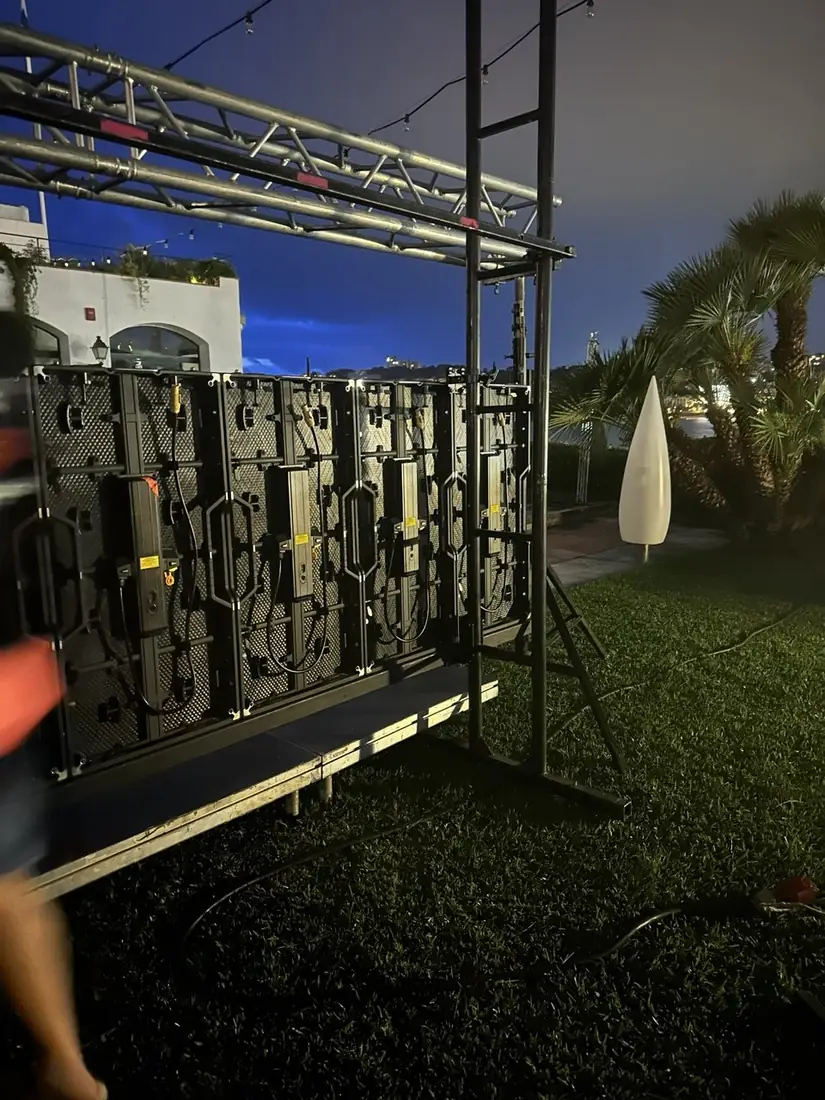
How a concert differs from a party
Technically these are two different jobs, and mixing them up is expensive.
- The audience came to listen: at a wedding music accompanies the evening, at a concert it is the event, so every detail of the sound is noticed;
- Monitoring is critical, because artists must hear themselves on stage, or the performance falls apart however good the hall sounds;
- The dynamic range is wider, from quiet moments to full volume, and the system must handle both ends;
- There is no right to a pause: a technical hitch at a banquet is waited out at the table, but at a concert it stops everything;
- The lighting follows the programme, working in step with the show rather than as background.
Outdoor concert sound and lighting on the coast
Finestrat is on the Costa Blanca, next to Benidorm, and open-air venues here have their own quirks.
- Sea wind affects how sound travels, so the speakers are placed differently than in a closed hall, and light structures are fixed down more firmly;
- Evening damp means equipment outdoors needs protection;
- With no reflecting surfaces, power is calculated with a reserve, because the sound has nothing to bounce off;
- Noise rules apply: at municipal events the finishing time is regulated, and the programme must fit inside it;
- Electricity is often short on an open site, and a generator is needed.
How we prepare a concert
- We receive the artist’s technical requirements in advance and compare them with what the venue can offer; the technical rider guide explains what such a document contains;
- We visit the location to measure, check power and access, and choose the place for the stage;
- We draw up a layout: where the stage, the sound and the desk go, and how the cable routes run;
- We set up a few hours before the event;
- We soundcheck with the artists before the audience comes in;
- A sound engineer and a technician stay for the whole performance.
Which events need the full concert set-up
A full concert rider is needed for more than concerts:
- Town and municipal celebrations;
- Festivals and open-air sites;
- Large corporate events with performances;
- Charity concerts for a community;
- Weddings of 200 guests or more with a live band on stage.
Single elements can also be taken on their own: sound and lighting, a stage, or a screen. If you also need a programme, Royal Band or Rock Beat can perform.
Why the band and the equipment come from one team
For a concert like this, the usual set-up is that musicians are found separately, equipment is hired separately and the installation is agreed with a third party. With us the musicians and the technical side come from one team, and that is our main difference.
- One party to answer to, so when something sounds wrong there is no argument about whose equipment or whose musicians;
- A desk the musicians already know, so the first set is not wasted learning another team’s kit;
- A sound engineer who knows the material, has heard the songs hundreds of times and feels where to lift a vocal and where to pull it back;
- One installation and one arrival, without three crews at the site at different times;
- Fewer arrangements, since one contact is enough instead of three.
In our experience, most technical failures at concerts and parties happen in the gaps between contractors, not in anybody’s own part of the work.
Who does what: our side and yours
Our side: checking what the venue can supply, selecting a line-up for the format, delivering and building every piece of equipment and running the soundcheck before people arrive. We also supply the engineer for the full show, watch the clock and clear the site at the end. A generator solves a power shortfall, and a smaller vehicle makes extra trips where a large one cannot get through.
Your side: the venue booking and our access arrangements with it, the food, a photographer, any songs that must be played and video for a screen. Partners can supply decor and filming. You sign the venue contract; we advise on what to ask.
For a very different format on the coast, see a live evening at an Irish pub in Orihuela Costa, where there was no stage and no screen, only sound and a band. For a full kit with stage and screen far from base, see the wedding near Girona.
Where we take stage and sound
Finestrat was one of our trips out of Alicante. Longer concert trips are possible too, since the crew has worked as far as Barcelona and Girona, and the cities page lists the distances. Anything beyond a few hundred kilometres is planned early, with the crew staying overnight.
How to order technical support for a concert
Describe the event in a message: date, city, venue, format and audience size. We answer the same day with a quote, after checking the site’s electricity, noise limits, build time and access, and we phone the venue ourselves when that is quicker. The date is fixed once conditions are agreed, the programme and timing are fixed some weeks in advance, and then we arrive early to build and test before the audience. Afterwards we take everything away. We set no advance deadline for a concert: send the date and we check the crew diary and reply.
Frequently asked questions
Do you work from the artist’s technical rider?
Yes. Send the technical requirements in advance and we will compare them with what the venue can offer and tell you what is missing.
How long does it take to prepare a concert?
Setting up a full kit takes a few hours, plus a soundcheck before the audience arrives. The venue must be available in good time.
What if the venue has no electricity?
We bring a generator. On open sites this is a standard situation, and the point is to find out about it beforehand.
Do you work at municipal events?
Yes, we work with private clients and with organisers of town events across Spain.
Can I hire only sound, without the stage and lighting?
Yes, the elements are taken separately, though a concert usually needs the full set.
Which languages does the team speak?
Questions about the technical side can be put to us in Spanish, English, Ukrainian or Russian, including in a conversation with an artist or organiser.
Organising a concert?
Send us the rider and the location, and we will price the technical side for your event.
Instagram @team5_entertainment · team@team5.es